Pre-Breakout Consolidation
Pre-Breakout Consolidation finds stocks that are quietly building at the top of their range, right before a likely breakout. The price is grinding sideways near its high, volume is fading, and the stock is primed to pop. It is a patience exercise, and it can hand you a name right before its move.
What it is
Most stocks do not break out on a random day. They break out from a base, after consolidating near a high. Buyers and sellers reach a standoff, volume dries up, and the range tightens. Then, when the standoff breaks, the stock moves.
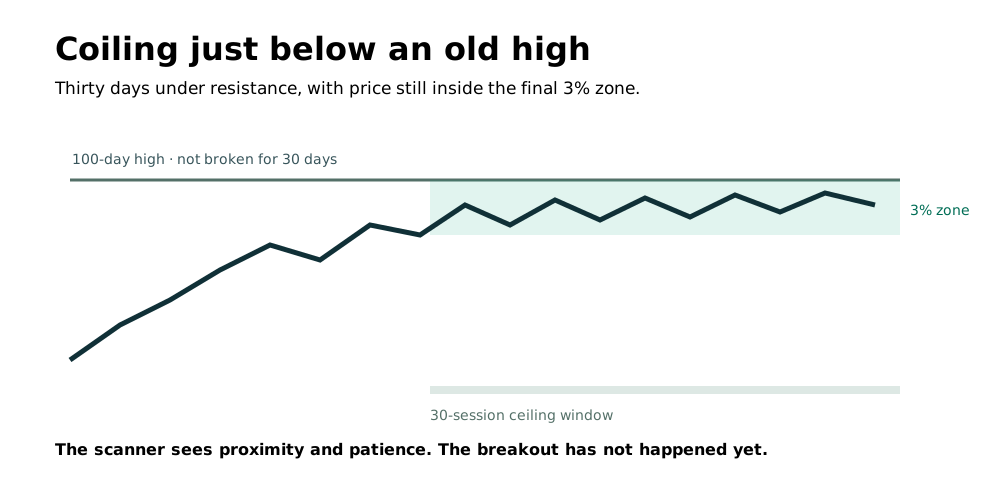
This scanner finds stocks in that final holding pattern. It looks for companies trading right at the top of their 100-day range, where the high has held without being broken for a month, and the price is hugging that ceiling, waiting to break.
The exact rule
A stock qualifies when all of these are true:
- It is within about 3% of its 100-day high.
- That 100-day high has not been broken in the last 30 days. The ceiling is holding.
- Its closing price is at least ₹50, and its market cap is at least ₹500 crore, keeping penny and micro-cap noise out.
- Its 20-day average volume is at least 50,000 shares, so it is liquid enough to act on.
Think of it this way: the stock has pushed up to a level, failed to break it for a month, and is sitting just below that ceiling, coiling.
Why the coiling matters
A stock that consolidates near its high is absorbing selling pressure. Every seller who wanted to exit at that level has had a month to do so. When the selling dries up, the path up clears.
The signature of this setup is the quiet tightening: a flat high that holds while volume fades. That combination, price near a ceiling that refuses to break and falling volume, is classic accumulation. The stock is being collected quietly before the push.
This scanner is different from the breakout scanners. It does not fire on the move. It fires before the move, while the stock is still coiling. The value is in finding the name early, then waiting.
What "primed" actually means
A pre-breakout setup is not a guarantee. Some consolidations resolve upward. Some fail and roll over. The setup improves the odds, it does not promise the outcome.
The correct use is to identify the candidates, set your watch, and then react when the breakout actually happens, ideally on volume. Pre-Breakout Consolidation is the setup scanner. Stage 2 Breakout is the confirmation scanner. Use them as two steps.
Why it matters
The best risk-reward in a move comes from being positioned before it starts, not after. A stock consolidating at the top of its range has a clear, near-by level it needs to clear, and a clear risk level if it fails.
Pre-Breakout Consolidation hands you the names that fit that profile, across the whole market, before the crowd sees the breakout. That is an edge.
Reading it with other signals
- Combine it with relative strength. A stock consolidating near a high with a high RS rating is a leader pausing, not a stock struggling.
- Pair it with a fundamental reason to break out. A stock coiling before a strong earnings report, or in a sector turning up, is a higher-probability setup.
- The 30-day flat high is the key detail. It tells you the selling at that level has had time to clear.
Where it fits
Pre-Breakout Consolidation is the setup arm of the breakout family. It looks backward at the base that forms before a move. It pairs with New 52-Week Highs and Stage 2 Breakout, which confirm moves after they start.