EMA 8/21 Cross
EMA 8/21 Cross is a short-term trend-acceleration scanner. It catches the moment the fast moving average crosses above the slow one, which is an early sign that the short-term trend is turning up.
First, what an EMA is
EMA stands for Exponential Moving Average. It is the average closing price over a window, but with one twist: recent days count more than older days.
You met the two kinds in the basics chapter. A simple moving average (SMA) treats every day equally. An exponential moving average (EMA) weights the most recent days more heavily, so it reacts faster to change.
This scanner uses two EMAs:
- The 8-day EMA, which follows price closely and reacts fast.
- The 21-day EMA, which is slower and smoother.
What the scanner does
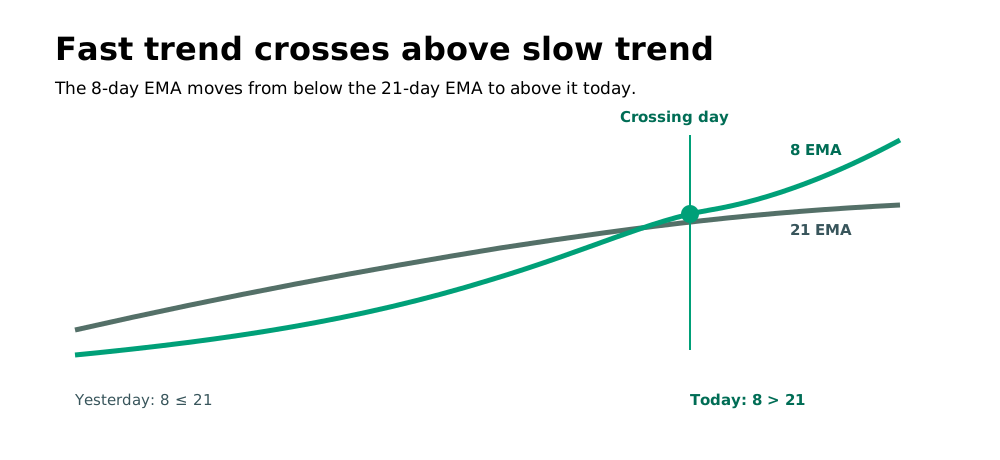
It watches the relationship between the 8-day EMA and the 21-day EMA. When the fast one crosses above the slow one, it is a signal that short-term momentum is turning up.
The exact rule
A stock qualifies when:
- Its 8-day EMA crossed above its 21-day EMA today.
- The day before, the 8-day EMA was still at or below the 21-day EMA.
It is a crossing event. The scan wants the exact day the fast average overtakes the slow one.
Why the crossing matters
When a fast moving average crosses above a slow one, it means recent prices are running ahead of the longer trend. The stock has accelerated recently.
The 8/21 cross is a short-term signal. It reacts quickly, which means it can catch a turn early. The trade-off is that short-term signals also produce more false leads in choppy, sideways markets. A stock can cross up, then cross back down, in a range.
This is why EMA 8/21 Cross works best as a timing tool within a bigger trend, not as a standalone story.
One more practical detail: the level where the averages crossed can matter after the fact. When a stock pulls back after a bullish cross, the price where the two averages crossed often acts as support, and on the way down it can act as resistance. It is a reference level many traders watch for a re-entry or an exit after a cross up. Not a rule, but a useful spot to look.
A stock that crossed and is now trending up, with the 8-day EMA still above the 21-day, has a confirmed short-term uptrend. One that crossed and immediately inverted does not.
Reading it in context
The 8/21 cross is most useful when combined with the longer-term picture:
- An 8/21 cross on a stock in a Stage 2 uptrend is a fresh acceleration within an established trend. Good timing confirmation.
- An 8/21 cross on a stock still basing or in decline is a short-term bounce. It may not last.
- The best use is as an entry-timing tool. The long-term story says the stock is worth owning. The 8/21 cross says the short-term turn is happening now.
Why it matters
Trend acceleration shows up in the short averages before it is obvious on the long chart. The 8/21 cross is one of the earliest moving-average signals, catching the turn while it is still young.
Because it is fast, it pairs naturally with the slower, more reliable signals. A stock that is in a confirmed Stage 2 and prints an 8/21 cross is showing both a long-term uptrend and a fresh short-term push. That combination is what this scanner is best at surfacing.
Where it fits
EMA 8/21 Cross is the short-term moving-average scanner, the sibling of Golden Cross, which uses the 50-day and 200-day SMAs for the long-term trend.
- EMA 8/21 Cross: fast, short-term, early.
- Golden Cross: slow, long-term, reliable.
Run them together to see both ends of the trend spectrum. A stock showing both an 8/21 cross and a golden cross is aligned across the short and long trends.