Darvas Box Breakout
Darvas Box Breakout is named after Nicolas Darvas, a self-taught trader who turned a small stake into millions in the 1950s. His method was strikingly simple: buy a stock only when it breaks out of a defined box on heavy activity, and never average down. This scanner applies his box method mechanically, on weekly charts, across the whole market.
The man and the method
Nicolas Darvas was a dancer, not a finance person. On tour, he followed stocks through newspapers and telegrams. He developed a system out of raw observation: strong stocks do not drift. They climb in steps.
He noticed a stock would trade in a band, an upper and lower limit, for a while. Then it would break above the upper limit on a burst of volume and climb to a new band. He called the band a box. Buy at the top of the box, not the bottom. When the stock breaks the top of the box on heavy volume, it is telling you the sellers at that level have been overcome. If it falls back below the bottom of the box, the story fails and you get out.
Two rules made it work. Never buy while the stock is inside the box, wait for the breakout. And never throw good money at a falling stock, exit if the box breaks down.
What a box is, in plain terms
A box is a price range the stock is trading inside. It has a top and a bottom.
In the Darvas approach, a box forms at a new high. The highest weekly high starts the box. If the stock keeps making higher highs, the box keeps moving up. Once the stock stops making higher weekly highs for a few weeks, the top and bottom of the box lock in. The stock is now trading inside a defined range.
The breakout is the moment the stock closes above the top of that locked box. That is the buy signal. It means demand has overcome supply at the highest recent level.
Darvas's own rules
Darvas's method came with two hard rules that made it work, and both are worth keeping in mind:
Rule one: buy at the box, never inside it. There is no value in buying a stock bouncing around inside its box. The trade only works when the box top breaks on heavy volume.
Rule two: a stop at the box bottom. If a stock falls back into its box after a breakout, or breaks the bottom of the box, Darvas got out. The box bottom is the defined line for the trade. This discipline is what keeps the method from blowing up on false breakouts.
The rising-box trail. As a stock breaks out and forms a new, higher box, the old box's ceiling becomes the new box's floor. That lets you trail a protective stop one box behind, protecting profits while letting the trend run. This is the classic Darvas way to ride a big move.
The exact rule in InvestorStack
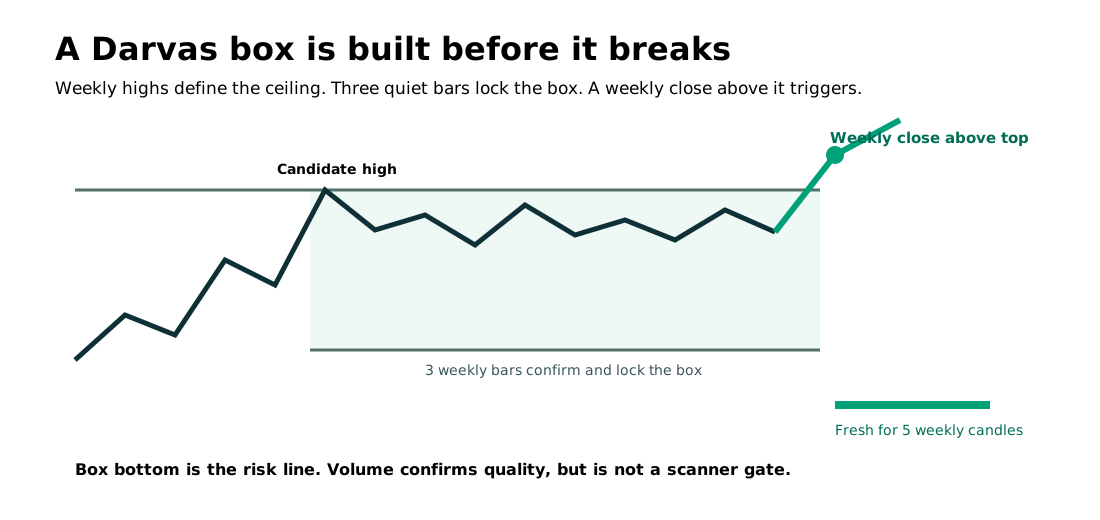
InvestorStack runs the Darvas box on weekly charts, mirroring the classic state machine. A stock qualifies when its weekly close breaks above its locked Darvas box top, and that breakout happened within the last 5 weekly candles. The full logic:
- A new 52-week high on the weekly chart starts a candidate box.
- If the stock makes a higher high, the box resets upward.
- Once 3 weekly bars pass without a higher high, the box top and bottom lock in.
- A close above the box top triggers the breakout.
- The breakout must be within the last 5 weekly bars to count.
The key detail: the breakout uses the weekly close above the box top, and it must be recent. This is the confirmation that the box has genuinely broken, not an old stale signal.
Why the confirmation bars matter
The three quiet weeks before a box locks in are the whole point. Darvas did not lock a box on a single high day. He waited for three weekly bars without a higher high, which told him the stock had stopped pushing and was settling into a defined range.
That patience is what makes the box reliable. A single spike to a high could be any one-off burst of buying. Three weeks of failing to make a higher high means the stock has genuinely found its ceiling for now, and both buyers and sellers have agreed on a range. The box top and bottom that get locked after that agreement are levels both sides have accepted, which is why they hold as real support and resistance afterwards.
The box bottom also persists after the breakout. It stays active as a support line until the stock breaks below it. That persistent floor is what carries your stop, keeping the defined exit in place even after the stock has moved on to a higher box.
The honest pitfalls
In the same plain frame: not every box breakout leads to a continued move. Some are false. A stock can punch above its box top on volume and then fold back inside, or break straight down through the box bottom. That is exactly why the stop at the box bottom matters. It is not about being right every time. It is about the payout when you are right dwarfing the small, defined loss when you are wrong.
The Darvas method is from the 1950s and was built reading newspaper prices and telegrams. The market is faster now, and the scanner runs the same discipline mechanically across thousands of stocks, which frees you from doing it by hand. The structure is the same even if the speed is not.
Why a box breakout works
A locked Darvas box is a concentration of supply and demand. At the box top, sellers have appeared repeatedly. Each weekly test of the top gives them a chance to sell. When a stock finally closes above that top, it means all those sellers have been absorbed and the stock is moving into price territory with no overhead supply.
That is the logic behind buying at the top of a box rather than the bottom. At the top, the stock is attacking resistance. When resistance breaks on volume, the move has room. At the bottom, the stock is still inside the range, and the breakout has not happened yet.
A stock whose box broke in the last couple of weeks and is holding above the box top is in a healthy post-breakout position. One that broke and fell back below the box bottom has failed.
Reading it with other signals
The Darvas box is a pure price-and-volume pattern. It gains power when combined:
- A box breakout with above-average volume confirms the buying.
- A box breakout in a stock already in a Stage 2 uptrend aligns the pattern with the trend.
- A box breakout with a high RS rating means the stock is strong relative to the market while it breaks out.
The classic Darvas approach was to carry a stock in a strong uptrend and add only when the box broke upward. Use the scanner to find the fresh box breakouts, then layer on the trend confirmation.
Where it fits
Darvas Box Breakout is one of the pattern scanners in the technical family, alongside the Minervini setups and Pre-Breakout Consolidation. It looks at the structure of the move, the steps and ranges, rather than just levels or momentum.