Breakout Retest
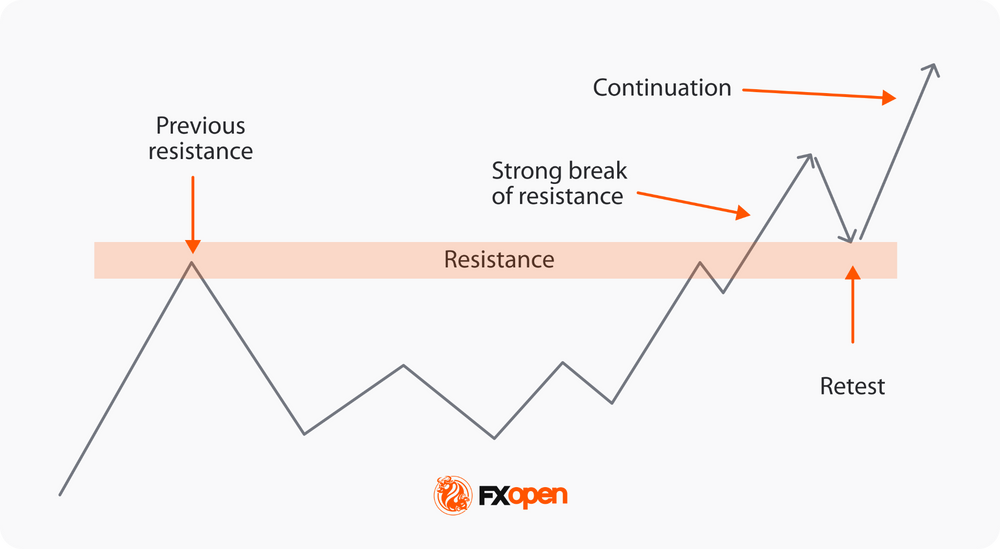
Breakout Retest finds stocks that broke above their 52-week high and then pulled back to test the broken level. This is the healthy pause after a breakout, where the old resistance turns into new support and the stock gets a second chance.
TIP
Author is not a fan of this scanner.
What it is
The natural way to think about a 52-week high is that it is resistance. Once a stock breaks above it, that level flips meaning. The old ceiling becomes a floor.
A breakout retest is what happens after a stock clears its 52-week high and then pulls back to that level. Buyers step in at the broken level, holding it as support. This scanner flags exactly that setup: a recent breakout, followed by a pullback to the breakout level.
First, what a breakout means
A breakout is when a stock's price moves beyond a level that has held it back, usually on higher volume. Think of a ceiling the stock has bounced off many times. Each time it tests the ceiling, sellers appear and push it back down. A breakout is the day it finally closes above that ceiling and keeps going.
Breakouts matter because they are where trends begin. When price breaks out of a long-held range, volatility tends to expand and the stock often trends in the breakout direction. That is why breakout setups are so watched: they are the starting point of the big moves.
But there is a catch. Not every move beyond a level is real. A fakeout, or false breakout, happens when price pokes through a level and then closes back inside the range. It looked like a breakout, but the sellers were still there. This is why confirmation matters, and it is exactly the job the retest does.
Why the role reversal is the mechanic
The retest works because of role reversal. When a stock breaks above a resistance level, that level flips meaning. The old ceiling becomes a floor. Buyers who were trapped waiting below it now defend it, and it turns into support. The same works in reverse: break a support level and it becomes resistance above.
That flip is the whole logic of the retest. The stock returns to the broken level, and if the level holds in its new role, the breakout is confirmed as real. If it fails, the breakout was false.
Why the retest matters
There are two ways to buy a breakout. You can buy the breakout itself, as it clears the level. Or you can wait for the pullback, the retest, when the stock comes back to the broken level and holds.
The retest is often the better risk-reward. You are buying at the breakout level, not extended above it. If the level holds, you have a clear stop just below it. The breakout validated the level, and the retest gives you a way in without chasing.
The exact rule
A stock qualifies when:
It broke out. Within the last 5 daily sessions, the stock closed above its prior 52-week high by at least 1%.
The level was a genuine ceiling. The 52-week high the stock broke was itself a long-held ceiling, not a fresh spike. The high measured a short time ago is within about 1% of the high measured 15 weeks ago, meaning it sat there for months before breaking.
It has pulled back. The stock is no longer extended. It has come off its recent peak.
It is retesting a support level. The close is within about 1% of the broken 52-week high, now acting as support, or within 1% of a short-term trend line (the 5, 6, or 10-day exponential moving average).
It is liquid. Its 20-day average volume is at least 500,000 shares, and its close is at least ₹5.
In plain words: a stock broke a real, long-held ceiling recently, pulled back, and is now testing that level as support.
The flat-base gate
The detail that separates a real retest from a fake one is the flat-base gate. A 52-week high can be a genuine long-term ceiling, or it can be a fresh spike off the lows, set only recently.
If the level was fresh, the "breakout" is not overcoming a year of overhead supply, it is just a recent high being nicked. The scanner requires the level to have sat unchallenged for months. That is what makes the breakout meaningful and the retest worth watching.
The setup is most useful when the retest is holding and the stock is turning back up, because that is the confirmation the level is holding as support.
Reading it with other signals
A retest is a risk-control setup. It works best combined:
- A retest holding on healthy volume is buyers defending the level. Strong.
- A retest in a stock in a Stage 2 uptrend aligns the pullback with the trend.
- A retest with a falling RS rating is a warning that the stock is losing strength while it pauses.
The beauty of the retest is the defined risk. If the level breaks, the setup fails and you know it immediately. That clean stop is why breakout traders favor the retest over the chase.
Why it matters
Buying extended breakouts is how people get burned. A stock that has run far above its breakout level can give it all back. The retest removes that risk by waiting for the stock to come back to the level before acting.
It is a patience play. Instead of chasing, you wait for the market to give you a second chance at the breakout level. When it does, and the level holds, you are in at support with a clear stop.
That stop is the clean part. Because the broken level is the line the trade stands on, you place your stop just below it. If the stock falls back through the level, the breakout failed and the trade is done. If it holds, you have bought at support with a small, defined loss if you are wrong. This is why the retest is beloved by patient traders: the risk is defined by the level itself, not by a guess.
The honest caveat
A retest does not always happen. Some breakouts run straight up and never come back to the level, and you simply miss those. That is the cost of waiting for confirmation, and it is a fair trade-off for avoiding the fakeouts.
The setup also works best in a trending market. In choppy, range-bound conditions, breakouts are less reliable, price flips back and forth through levels, and retests fail more often. Read this scanner the same way: strongest when the stock has genuine momentum and a real story behind the breakout, weaker when the move has no follow-through.
Where it fits
Breakout Retest is the logical next step after New 52-Week Highs. That scanner finds the breakouts. This one finds the healthy pullback after the breakout. Run them together: first find the new highs, then watch for the retest of the freshly broken level.